Bangladesh

Bangladesh

Jump to navigationJump to search
People's Republic of Bangladesh
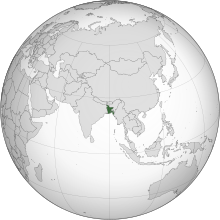
Location of Bangladesh
Capital
and largest city
Dhaka
23°42′N 90°21′E
Official languagesBengali[2]
Ethnic groups (2011[3])
Religion (2011[4])
DemonymBangladeshi
GovernmentUnitary parliamentaryrepublic
Abdul Hamid
Sheikh Hasina
Shirin Chaudhury
Syed Mahmud Hossain
LegislatureJatiya Sangsad
Formation and independence
14 August 1947
14 October 1955
26 March 1971
16 December 1971
4 November 1972
Area
147,570[5] km2(56,980 sq mi) (92nd)
6.4
Population
162,951,560[6] (8th)
149,772,364[7] (8th)
1,106/km2(2,864.5/sq mi) (10th)
GDP (PPP)2018 estimate
$751.949 billion[8] (31st)
$4,561[8] (139th)
GDP (nominal)2018 estimate
$285.817 billion[8] (43rd)
$1,754[8] (148th)
Gini (2017)Negative increase 32.4[9]
medium · 19
HDI (2018)Increase 0.608[10]
medium · 136th
CurrencyTaka () (BDT)
Time zoneUTC+6 (BST)
Date format
Driving sideleft
Calling code+880
ISO 3166 codeBD
Internet TLD.bd
.বাংলা
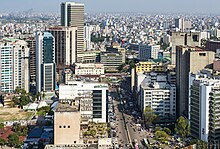
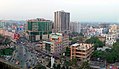
Bangladesh (/ˌbæŋɡləˈdɛʃˌbɑːŋ-/ (About this sound listen)Bengaliবাংলাদেশ Bangladesh [ˈbaŋladeʃ] (About this sound listen)lit. "The country of Bengal"), officially the People's Republic of Bangladesh (গণপ্রজাতন্ত্রী বাংলাদেশ Gônoprojatontri Bangladesh), is a country in South Asia. It shares land borders with India and Myanmar (Burma).The country's maritime territory in the Bay of Bengal is roughly equal to the size of its land area.[11] Bangladesh is the world's eighth most populous countryDhaka is its capital and largest city, followed by Chittagong, which has the country's largest port. Bangladesh forms the largest and easternmost part of the Bengal region.[12] Bangladeshis include people from a range of ethnic groups and religions. Bengalis, who speak the official Bengali language, make up 98% of the population.[2][3] The politically dominant Bengali Muslims make the nation the world's third largest Muslim-majority countryIslam is the official religion of Bangladesh.[13][14]
The Greeks and Romans identified the region as Gangaridai, a powerful kingdom of the historical Indian subcontinent, in the 3rd century BCE. Archaeological research has unearthed several ancient cities in Bangladesh, which enjoyed international trade links for millennia.[15] The Bengal Sultanate and Mughal Bengal transformed the region into a cosmopolitan Islamic imperial power between the 14th and 18th centuries. The region was home to many principalities that made use of their inland naval prowess.[16][17] It was also a notable center of the global muslin and silk trade. As part of British India, the region was influenced by the Bengali renaissance and played an important role in anti-colonial movements. The Partition of British India made East Bengal a part of the Dominion of Pakistan; and renamed it as East Pakistan. The region witnessed the Bengali Language Movement in 1952 and the Bangladesh Liberation War in 1971.[18] After independence was achieved, a parliamentary republic was established. A presidential government was in place between 1975 and 1990, followed by a return to parliamentary democracy. The country continues to face challenges in the areas of povertyeducationhealthcare and corruption.
Bangladesh is a middle power and a developing nation. Listed as one of the Next Eleven, its economy ranks 43rd in terms of nominal gross domestic product and 29th in terms of purchasing power parity. It is one of the largest textile exporters in the world. Its major trading partners are the European Union, the United States, China, India, JapanMalaysia and Singapore. With its strategically vital location between SouthEast and Southeast Asia, Bangladesh is an important promoter of regional connectivity and cooperation. It is a founding member of SAARCBIMSTEC, the Bangladesh-China-India-Myanmar Forum for Regional Cooperation and the Bangladesh Bhutan India Nepal Initiative. It is also a member of the Organisation of Islamic CooperationCommonwealth of Nations, the Developing 8 Countries, the OIC, the Indian-Ocean Rim Association, the Non Aligned Movement, the Group of 77 and the World Trade Organization. Bangladesh is one of the largest contributors to United Nations peacekeeping forces.

Etymology

History

Early and medieval periods

Stone Age tools found in Bangladesh indicate human habitation for over 20,000 years,[28] and remnants of Copper Age settlements date back 4,000 years.[28] Ancient Bengal was settled by AustroasiaticsTibeto-Burmans, Dravidians and Indo-Aryans in consecutive waves of migration.[29][28] Archaeological evidence confirms that by the second millennium BCE, rice-cultivating communities inhabited the region. By the 11th century people lived in systemically-aligned housing, buried their dead, and manufactured copper ornaments and black and red pottery.[30] The GangesBrahmaputra and Meghna rivers were natural arteries for communication and transportation,[30] and estuaries on the Bay of Bengal permitted maritime trade. The early Iron Age saw the development of metal weaponry, coinage, agriculture and irrigation.[30] Major urban settlements formed during the late Iron Age, in the mid-first millennium BCE,[31] when the Northern Black Polished Ware culture developed.[32] In 1879, Alexander Cunningham identified Mahasthangarh as the capital of the Pundra Kingdom mentioned in the Rigveda.[33][34]
Early Muslim explorers and missionaries arrived in Bengal late in the first millennium CE. The Islamic conquest of Bengal began with the 1204 invasion by Bakhtiar Khilji; after annexing Bengal to the Delhi Sultanate, Khilji waged a military campaign in Tibet. Bengal was ruled by the Delhi Sultanate for a century by governors from the Mamluk, Balban and Tughluq dynasties. During the 14th century, an independent Bengal Sultanate was established by rebel governors. The sultanate's ruling houses included the Ilyas ShahiJalaluddin Muhammad ShahHussain ShahiSuri and Karrani dynasties, and the era saw the introduction of a distinct mosque architecture[38] and the tangka currency. The Arakan region was brought under Bengali hegemony. The Bengal Sultanate was visited by explorers Ibn BattutaAdmiral Zheng He and Niccolo De Conti. During the late 16th century, the Baro-Bhuyan (a confederation of Muslim and Hindu aristocrats) ruled eastern Bengal; its leader was the Mansad-e-Ala,[17] a title held by Isa Khan and his son Musa Khan. The Khan dynasty are considered local heroes for resisting North Indian invasions with their river navies.
The Mughal Empire controlled Bengal by the 17th century. During the reign of Emperor Akbar, the Bengali agrarian calendar was reformed to facilitate tax collection. The Mughals established Dhaka as a fort city and commercial metropolis, and it was the capital of Mughal Bengal for 75 years.[39] In 1666, the Mughals expelled the Arakanese from Chittagong. Mughal Bengal attracted foreign traders for its muslin and silk goods, and the Armenians were a notable merchant community. A Portuguese settlement in Chittagong flourished in the southeast, and a Dutch settlement in Rajshahi existed in the north. During the 18th century, the Nawabs of Bengal became the region's de facto rulers. The Nawabs forged alliances with European colonial companies, which made the region relatively prosperous early in the century.
The Bengali Muslim population was a product of conversion and religious evolution,[40] and their pre-Islamic beliefs included elements of Buddhism and Hinduism. The construction of mosques, Islamic academies (madrasas) and Sufi monasteries (khanqahs) facilitated conversion, and Islamic cosmology played a significant role in developing Bengali Muslim society. Scholars have theorized that Bengalis were attracted to Islam by its egalitarian social order, which contrasted with the Hindu caste system.[41] By the 15th century, Muslim poets were writing in the Bengali language. Notable medieval Bengali Muslim poets included Daulat QaziAbdul Hakim and AlaolSyncretic cults, such as the Baul movement, emerged on the fringes of Bengali Muslim society. The Persianate culture was significant in Bengal, where cities like Sonargaon became the easternmost centers of Persian influence.[42][43]

Colonial period

After the 1757 Battle of Plassey, Bengal was the first region of the Indian subcontinent conquered by the British East India Company. The company formed the Presidency of Fort William, which administered the region until 1858. A notable aspect of company rule was the Permanent Settlement, which established the feudal zamindari system. A number of famines, including the great Bengal famine of 1770, occurred under company rule. Several rebellions broke out during the early 19th century (including one led by Titumir), but British rule displaced the Muslim ruling class. A conservative Islamic cleric, Haji Shariatullah, sought to overthrow the British by propagating Islamic revivalism. Several towns in Bangladesh participated in the Indian Mutiny and pledged allegiance to the last Mughal emperor, Bahadur Shah Zafar, who was later exiled to neighboring Burma.
The challenge posed to company rule by the failed Indian Mutiny led to the creation of the British Indian Empire as a crown colony, and the first railway was built in 1862.[44] Syed Ahmed Khan and Ram Mohan Roy promoted modern and liberal education on the subcontinent, inspiring the Aligarh movement and the Bengal Renaissance. During the late 19th century, novelists, social reformers and feminists emerged from Muslim Bengali society. Electricity and municipal water systems were introduced in the 1890s; cinemas opened in many towns during the early 20th century. East Bengal's plantation economy was important to the British Empire, particularly its jute and tea. The British established tax-free river ports, such as the Port of Narayanganj, and large seaports like the Port of Chittagong.
Social tensions also increased under British rule, particularly between wealthy Hindus and the Muslim-majority population. The Permanent Settlement made millions of Muslim peasants tenants of Hindu estates, and resentment of the Hindu landed gentry grew.[45] Supported by the Muslim aristocracy, the British government created the province of Eastern Bengal and Assam in 1905; the new province received increased investment in education, transport and industry. However, the first partition of Bengal created an uproar in Calcutta and the Indian National Congress. In response to growing Hindu nationalism, the All India Muslim League was formed in Dhaka during the 1906 All India Muhammadan Educational Conference. The British government reorganized the provinces in 1912, reuniting East and West Bengal and making Assam a second province.
The Raj was slow to allow self-rule in the colonial subcontinent. It established the Bengal Legislative Council in 1862, and the council's native Bengali representation increased during the early 20th century. The Bengal Provincial Muslim League was formed in 1913 to advocate civil rights for Bengali Muslims within a constitutional framework. During the 1920s, the league was divided into factions supporting the Khilafat movement and favoring cooperation with the British to achieve self-rule. Segments of the Bengali elite supported Mustafa Kemal Ataturk secularist forces.[46] In 1929, the All Bengal Tenants Association was formed in the Bengal Legislative Council to counter the influence of the Hindu landed gentry, and the Indian Independence and Pakistan Movements strengthened during the early 20th century. After the Morley-Minto Reforms and the diarchy era in the legislatures of British India, the British government promised limited provincial autonomy in 1935. The Bengal Legislative Assembly, British India's largest legislature, was established in 1937.
Although it won a majority of seats in 1937, the Bengal Congress boycotted the legislature. A. K. Fazlul Huq of the Krishak Praja Party was elected as the first Prime Minister of Bengal. In 1940 Huq supported the Lahore Resolution, which envisaged independent states in the northwestern and eastern Muslim-majority regions of the subcontinent. The first Huq ministry, a coalition with the Bengal Provincial Muslim League, lasted until 1941; it was followed by a Huq coalition with the Hindu Mahasabha which lasted until 1943. Huq was succeeded by Khawaja Nazimuddin, who grappled with the effects of the Burma Campaign, the Bengal famine of 1943 and the Quit India movement. In 1946, the Bengal Provincial Muslim League won the provincial election, taking 113 of the 250-seat assembly (the largest Muslim League mandate in British India). H. S. Suhrawardy, who made a final futile effort for a United Bengal in 1946, was the last premier of Bengal.

Union with Pakistan

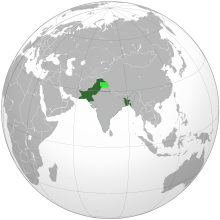
On 3 June 1947 Mountbatten Plan outlined the partition of British India. On 20 June, the Bengal Legislative Assembly met to decide on the partition of Bengal. At the preliminary joint meeting, it was decided (120 votes to 90) that if the province remained united it should join the Constituent Assembly of Pakistan. At a separate meeting of legislators from West Bengal, it was decided (58 votes to 21) that the province should be partitioned and West Bengal should join the Constituent Assembly of India. At another meeting of legislators from East Bengal, it was decided (106 votes to 35) that the province should not be partitioned and (107 votes to 34) that East Bengal should join the Constituent Assembly of Pakistan if Bengal was partitioned.[47] On 6 July, the Sylhet region of Assam voted in a referendum to join East BengalCyril Radcliffe was tasked with drawing the borders of Pakistan and India, and the Radcliffe Line established the borders of present-day Bangladesh. The Dominion of Pakistan was created on 14 August 1947.
Khawaja Nazimuddin was East Bengal's first chief minister with Frederick Chalmers Bourne its governor. The All Pakistan Awami Muslim League was formed in 1949 as a centre-left alternative to the centre-right All Pakistan Muslim League.[citation needed] In 1950, the East Bengal Legislative Assembly enacted land reform, abolishing the Permanent Settlement and the zamindari system.[52] The 1952 Bengali Language Movement was the first sign of friction between the country's geographically-separated wings. The Awami Muslim League was renamed the more-secular Awami League in 1953.[53] The first constituent assembly was dissolved in 1954; this was challenged by its East Bengali speaker, Maulvi Tamizuddin Khan. The United Front coalition swept aside the Muslim League in a landslide victory in the 1954 East Bengali legislative election. The following year, East Bengal was renamed East Pakistan as part of the One Unit program and the province became a vital part of the Southeast Asia Treaty Organization.
Pakistan adopted its first constitution in 1956. Three Bengalis were its Prime Minister until 1957: Nazimuddin, Mohammad Ali of Bogra and Suhrawardy. None of the three completed their terms, and resigned from office. The Pakistan Army imposed military rule in 1958, and Ayub Khan was the country's strongman for 11 years. Political repression increased after the coup. Khan introduced a new constitution in 1962, replacing Pakistan's parliamentary system with a presidential and gubernatorial system (based on electoral college selection) known as Basic Democracy. In 1962 Dhaka became the seat of the National Assembly of Pakistan, a move seen as appeasing increased Bengali nationalism.[54] The Pakistani government built the controversial Kaptai Dam, displacing the Chakma people from their indigenous homeland in the Chittagong Hill Tracts.[55] During the 1965 presidential electionFatima Jinnah lost to Ayub Khan despite support from the Combined Opposition alliance (which included the Awami League).[56] The Indo-Pakistani War of 1965 blocked cross-border transport links with neighboring India in what is described as a second partition.[57] In 1966, Awami League leader Sheikh Mujibur Rahman announced a six point movement for a federal parliamentary democracy.
Ethnic and linguistic discrimination was common in Pakistan's civil and military services, in which Bengalis were under-represented. Fifteen percent of Pakistani central-government offices were occupied by East Pakistanis, who formed 10 percent of the military.[60][61]Cultural discrimination also prevailed, making East Pakistan forge a distinct political identity.[62] Pakistan banned Bengali literature and music in state media, including the works of Nobel laureate Rabindranath Tagore.[63] A cyclone devastated the coast of East Pakistan in 1970, killing an estimated 500,000 people,[64] and the central government was criticized for its poor response.[65] After the December 1970 elections, calls for the independence of East Bengal became louder;[66] the Bengali-nationalist Awami League won 167 of 169 East Pakistani seats in the National Assembly. The League claimed the right to form a government and develop a new constitution, but was strongly opposed by the Pakistani military and the Pakistan Peoples Party (led by Zulfikar Ali Bhutto).

War of Independence

The Bengali population was angered when Prime Minister-elect Sheikh Mujibur Rahman was prevented from taking the office.[67]Civil disobedience erupted across East Pakistan, with calls for independence.[68] Mujib addressed a pro-independence rally of nearly 2 million people in Dacca on 7 March 1971, where he said, "This time the struggle is for our freedom. This time the struggle is for our independence." The flag of Bangladesh was raised for the first time on 23 March, Pakistan's Republic Day.[69] During the night of 25 March, the Pakistani military junta led by Yahya Khan launched Operation Searchlight (a sustained military assault on East Pakistan).[70][71] Pakistan army arrested Sheikh Mujibur Rahman and flew him away to Karachi.[72][73][74] Mujib however, before his arrest proclaimed the Independence of Bangladesh on 26 March midnight which led the Bangladesh Liberation War to officially break out within hours. The Pakistan Army continued to massacre Bengali studentsintellectuals, politicians, civil servants and military defectors in the 1971 Bangladesh genocide, while the Mukti Bahini and other Bengali guerilla forces created strong resistance throughout the country.[75] During the war, an estimated 300,000 to three million people were killed and several million people took shelter in neighboring India.[76] Global public opinion turned against Pakistan as news of the atrocities spread;[77] the Bangladesh movement was supported by prominent political and cultural figures in the West, including Ted KennedyGeorge HarrisonBob DylanJoan BaezVictoria Ocampo and André Malraux.[78][79][80] The Concert for Bangladesh was held at Madison Square Garden in New York City to raise funds for Bangladeshi refugees. The first major benefit concert in history, it was organized by Harrison and Indian Bengali sitarist Ravi Shankar.[81]
During the Bangladesh Liberation War, Bengali nationalists declared independence and formed the Mukti Bahini (the Bangladeshi National Liberation Army). The Provisional Government of Bangladesh was established on 17 April 1971, converting the 469 elected members of the Pakistani national assembly and East Pakistani provincial assembly into the Constituent Assembly of Bangladesh. The provisional government issued the Proclamation of the Independence of Bangladeshi, which was the country's interim constitution and declared "equality, human dignity and social justice" as its fundamental principles. Due to Mujib's detention, the acting president was Syed Nazrul Islam, while Tajuddin Ahmad was Bangladesh's first prime minister. The military wing of the provisional government was the Bangladesh Forces that included Mukti Bahini and other Bengali guerilla forces. Led by General M. A. G. Osmani and eleven sector commanders, the forces strongly held the countryside during the war and conducted wide-ranging guerrilla operations against Pakistani forces. As a result, almost entire country except capital Dacca was liberated by Bangladesh Forces by late November. This led Pakistan Army to attack neighboring India's western front on 2 December. India retaliated both in western and eastern fronts. By joint Bangladeshi ground advance and Indian air strike, the rest capital Dacca was liberated from Pakistani occupation in mid December. During the last phase of the war, the Soviet Union and the United States dispatched naval forces to the Bay of Bengal in a Cold War standoff. The nine-months long war ended with the surrender of Pakistani armed forces to the Bangladesh-India Allied Forces on 16 December 1971.[82][83] Under international pressure, Pakistan released Rahman from imprisonment on 8 January 1972 and he was flown by the British Royal Air Force of to a million-strong homecoming in Dacca.[84][85] Remaining Indian troops were withdrawn by 12 March 1972, three months after the war ended.[86]

People's Republic of Bangladesh

First parliamentary era

The constituent assembly adopted Bangladesh's constitution on 4 November 1972, establishing a secular, multiparty parliamentary democracy. The new constitution included references to socialism, and Prime Minister Sheikh Mujibur Rahman nationalized major industries in 1972.[88] A major reconstruction and rehabilitation program was launched. The Awami League won the country's first general election in 1973, securing a large majority in the Jatiyo Sangshad. Bangladesh joined the Commonwealth of Nations, the UN, the OIC and the Non-Aligned Movement, and Rahman strengthened ties with India. Amid growing agitation by the opposition National Awami Party and National Socialist Party, he became increasingly authoritarian. Rahman amended the constitution, giving himself more emergency powers (including the suspension of fundamental rights). The Bangladesh famine of 1974 also worsened the political situation.[89]

Presidential era and coups (1975–1991)

In January 1975, Sheikh Mujibur Rahman introduced one-party socialist rule under BAKSAL. Rahman banned all newspapers except four state-owned publications, and amended the constitution to increase his power. He was assassinated during a coup on 15 August 1975. Martial law was declared, and the presidency passed to the usurper Khondaker Mostaq Ahmad for four months. Ahmad is widely regarded as a quisling by Bangladeshis.[90] Tajuddin Ahmad, the nation's first prime minister, and four other independence leaders were assassinated on 4 November 1975. Chief Justice Abu Sadat Mohammad Sayem was installed as president by the military on 6 November 1975. Bangladesh was governed by a military junta led by the Chief Martial Law Administrator for three years. In 1977, Army chief Ziaur Rahman became president. Rahman reinstated multiparty politics, privatized industries and newspapers, established BEPZA and held the country's second general election in 1979. A semi-presidential system evolved, with the Bangladesh Nationalist Party (BNP) governing until 1982. Rahman was assassinated in 1981, and was succeeded by Vice President Abdus Sattar. Sattar received 65.5 percent of the vote in the 1981 presidential election.[91]
After a year in office, Sattar was overthrown in the 1982 Bangladesh coup d'état. Chief Justice A. F. M. Ahsanuddin Chowdhury was installed as president, but army chief Hussain Muhammad Ershad became the country's de facto leader and assumed the presidency in 1983. Ershad lifted martial law in 1986. He governed with four successive prime ministers (Ataur Rahman KhanMizanur Rahman ChowdhuryMoudud Ahmed and Kazi Zafar Ahmed) and a parliament dominated by his Jatiyo Party. General elections were held in 1986 and 1988, although the latter was boycotted by the opposition BNP and Awami League. Ershad pursued administrative decentralization, dividing the country into 64 districts, and pushed Parliament to make Islam the state religion in 1988.[92] A 1990 mass uprising forced him to resign, and Chief Justice Shahabuddin Ahmed led the country's first caretaker government as part of the transition to parliamentary rule.[91]

Current parliamentary era (1991–present)

After an Awami League initiative, the BNP introduced a system of caretaker governments to oversee the transfer of power. Justice Muhammad Habibur Rahman was the first Chief Adviser of Bangladesh, and oversaw the 1996 election. The Awami League, led by Sheikh Hasina, won the seventh general election. Hasina's first term was highlighted by the Chittagong Hill Tracts Peace Accord and a Ganges water-sharing treaty with India. The second caretaker government, led by Chief Adviser Justice Latifur Rahman, oversaw the eighth general election in 2001 which returned Begum Zia and the BNP to power. The second Zia ministry saw improved economic growth, but political turmoil gripped the country between 2004 and 2006. A radical Islamist militant group, the JMB, carried out a series of bombings. Amid widespread political unrest the Bangladeshi military urged President Iajuddin Ahmed to impose a state of emergency and a caretaker government, led by technocrat Fakhruddin Ahmed, was installed.[89]

Geography

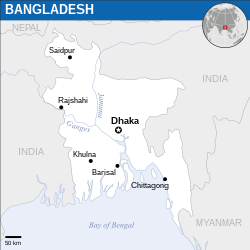
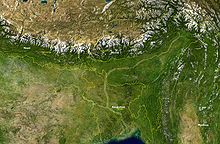
The geography of Bangladesh is divided between three regions. Most of the country is dominated by the fertile Ganges-Brahmaputra delta; the northwest and central parts of the country are formed by the Madhupur and the Barind plateaus. The northeast and southeast are home to evergreen hill ranges. The Ganges delta is formed by the confluence of the Ganges (local name Padma or Pôdda), Brahmaputra (Jamuna or Jomuna), and Meghna rivers and their respective tributaries. The Ganges unites with the Jamuna (main channel of the Brahmaputra) and later joins the Meghna, finally flowing into the Bay of Bengal. Bangladesh has 57 trans-boundary rivers, making the resolution of water issues politically complicated, in most cases, as the country is a lower riparian state to India.[96]

Administrative geography

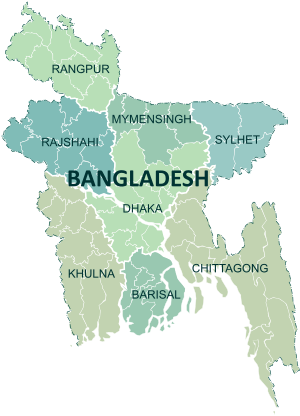
Rangpur DivisionRajshahi DivisionKhulna DivisionMymensingh DivisionDhaka DivisionBarisal DivisionSylhet DivisionChittagong DivisionA clickable map of Bangladesh exhibiting its divisions.
About this image
Administrative Divisions of Bangladesh
DivisionCapitalEstablishedArea (km2)[103]Population[103]Density[103]
Barisal DivisionBarisal1 January 199313,2978,325,666626
Chittagong DivisionChittagong1 January 182933,77128,423,019841
Dhaka DivisionDhaka1 January 182920,59336,054,4181,751
Khulna DivisionKhulna1 October 196022,27215,687,759704
Mymensingh DivisionMymensingh14 September 201510,58411,370,0001,074
Rajshahi DivisionRajshahi1 January 182918,19718,484,8581,015
Rangpur DivisionRangpur25 January 201016,31715,787,758960
Sylhet DivisionSylhet1 August 199512,5969,910,219780

Climate

Biodiversity

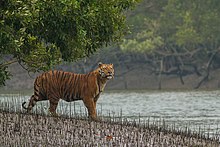
Bangladesh is located in the Indomalaya ecozone. Its ecology includes a long sea coastline, numerous rivers and tributaries, lakes, wetlands, evergreen forests, semi evergreen forests, hill forests, moist deciduous forests, freshwater swamp forests and flat land with tall grass. The Bangladesh Plain is famous for its fertile alluvial soil which supports extensive cultivation. The country is dominated by lush vegetation, with villages often buried in groves of mangojackfruitbamboobetel nutcoconut and date palm.[114] The country has up to 6000 species of plant life, including 5000 flowering plants.[115] Water bodies and wetland systems provide a habitat for many aquatic plants. Water lilies and lotuses grow vividly during the monsoon season. The country has 50 wildlife sanctuaries.

Politics

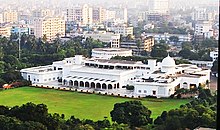
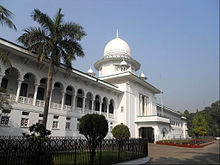
The Constitution of Bangladesh established a unitaryWestminster-style parliamentary republic with universal suffrage. A member of parliament supported by a parliamentary majority (usually the chair of the largest party) is the Prime Minister, the head of government and of the cabinet. Bangladesh is governed by a 350-member parliament, known as the Jatiyo Sangshad. Three hundred of its members are elected on a first past the post basis, and 50 seats are reserved for female nominees by political parties. Although parliamentary elections are scheduled every five years, they have often been delayed by political crises, emergency rule or martial law. The President of Bangladesh is the head of state. From 1975 to 1990 the presidency had executive powers, but it has been reduced to a largely-ceremonial role by the Twelfth Amendment to the constitution.

Legal system

Bangladesh's legal system is based on common law, and its principal source of laws are acts of Parliament.[124] The Bangladesh Code includes a list of all laws in force in the country. The code begins in 1836, and most of its listed laws were crafted under the British Raj by the Bengal Legislative Council, the Bengal Legislative Assembly, the Eastern Bengal and Assam Legislative Council, the Imperial Legislative Council and the Parliament of the United Kingdom; one example is the 1860 Penal Code. From 1947 to 1971, laws were enacted by Pakistan's national assembly and the East Pakistani legislature. The Constituent Assembly of Bangladesh was the country's provisional parliament until 1973, when the first elected Jatiyo Sangshad was sworn in. Although most of Bangladesh's laws were compiled in English, after a 1987 government directive laws are now primarily written in Bengali. Marriage, divorce and inheritance are governed by IslamicHindu and Christian family law. The judiciary is often influenced by legal developments in the Commonwealth of Nations, such as the doctrine of legitimate expectation.

Military

Foreign relations

Bangladesh's most politically-important bilateral relationship is with neighboring India. In 2015, major Indian newspapers called Bangladesh a "trusted friend".[138] Bangladesh and India are South Asia's largest trading partners. The countries are forging regional economic and infrastructure projects, such as a regional motor-vehicle agreement in eastern South Asia and a coastal shipping agreement in the Bay of BengalIndo-Bangladesh relations have a shared cultural heritage and democratic values and a history of support for Bangladeshi independence. Despite political goodwill, border killings of Bangladeshi civilians and the lack of a comprehensive water-sharing agreement for 54 trans-boundary rivers are major issues. In 2017, India joined Russia and China in refusing to condemn Myanmar's atrocities against the Rohingya, which contradicted with Bangladesh's demand for recognizing Rohingya human rights.[139] However, the Indian air force delivered aid shipments for Rohingya refugees in Bangladesh.[140] The rise of Hindu extremism and Islamophobia in India has also affected Bangladesh. The Bangladeshi beef and leather industries have seen increased prices due to the Indian BJP government's Hindu nationalist campaign against the export of beef and cattle skin.[141]

Human rights

Corruption

Economy

During its first five years of independence Bangladesh adopted socialist policies, an Awami League blunder.[citation needed] The subsequent military regime and BNP and Jatiya Party governments restored free markets and promoted the country's private sector. In 1991, finance minister Saifur Rahman introduced a programme of economic liberalization. The Bangladeshi private sector has rapidly expanded, with a number of conglomerates driving the economy. Major industries include textiles, pharmaceuticals, shipbuilding, steel, electronics, energy, construction materials, chemicals, ceramics, food processing and leather goods. Export-oriented industrialization has increased, with fiscal year 2014–15 exports increasing by 3.3% over the previous year to $30 billion, although Bangladesh's trade deficit ballooned by over 45% in this same time period.[179] Most export earnings are from the garment-manufacturing industry. Bangladesh also has social enterprises, including the Nobel Peace Prize-winning Grameen Bank and BRAC (the world's largest non-governmental organisation).[180][181]
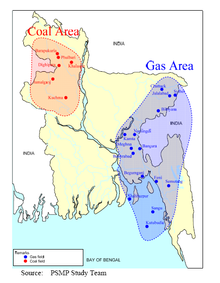
The country is notable for its soil fertility land, including the Ganges DeltaSylhet Division and the Chittagong Hill Tracts. Agriculture is the largest sector of the economy, making up 18.6 percent of Bangladesh's GDP in November 2010 and employing about 45 percent of the workforce.[184] The agricultural sector impacts employment generation, poverty alleviation, human resources development and food security. More Bangladeshis earn their living from agriculture than from any other sector. The country is among the top producers of rice (fourth), potatoes (seventh), tropical fruits (sixth), jute (second), and farmed fish (fifth).[185][186] Bangladesh is the seventh-largest natural gas producer in Asia, ahead of neighboring Myanmar, and 56 percent of the country's electricity is generated by natural gas. Major gas fields are located in the northeastern (particularly Sylhet) and southern (including Barisal and Chittagong) regions. PetroBangla is the national energy company. The American multinational corporation Chevron produces 50 percent of Bangladesh's natural gas.[187] According to geologists, the Bay of Bengal contains large, untapped gas reserves in Bangladesh's exclusive economic zone.[188] Bangladesh has substantial coal reserves, with several coal mines operating in the northwest. Jute exports remain significant, although the global jute trade has shrunk considerably since its World War II peak. Bangladesh has one of the world's oldest tea industries, and is a major exporter of fish and seafood.
Share of world GDP (PPP)[189]
YearShare
19800.31%
19900.33%
20000.36%
20100.44%
20170.54%

Transport

Top maritime and inland ports

RankPortTypeTEU traffic
1Port of ChittagongSeaport2.3 million
2Port of PangaonRiver port116,000
3Port of MonglaSeaport70,000
4Port of DhakaRiver port
5Port of NarayanganjRiver port
6Port of AshuganjRiver port
7Port of PayraSeaport
8Aricha GhatRiver port
9GoalondoRiver port

Energy and infrastructure

Science and technology

Tourism

The World Travel and Tourism Council (WTTC) reported in 2013 that the travel and tourism industry in Bangladesh directly generated 1,281,500 jobs in 2012 or 1.8 percent of the country's total employment, which ranked Bangladesh 157 out of 178 countries worldwide.[215] Direct and indirect employment in the industry totalled 2,714,500 jobs, or 3.7 percent of the country's total employment.[215] The WTTC predicted that by 2023, travel and tourism will directly generate 1,785,000 jobs and support an overall total of 3,891,000 jobs, or 4.2 percent of the country's total employment.[215] This would represent an annual growth rate in direct jobs of 2.9 percent.[215] Domestic spending generated 97.7 percent of direct travel and tourism gross domestic product (GDP) in 2012.[215] Bangladesh's world ranking in 2012 for travel and tourism's direct contribution to GDP, as a percentage of GDP, was 142 out of 176.[215]

Demographics

Population (millions)
YearPop.±% p.a.
197167.8—    
198080.6+1.94%
1990105.3+2.71%
2000129.6+2.10%
2010148.7+1.38%
2012161.1+4.09%
Source: OECD/World Bank[216]

Urban centres

Languages

Religion

Education

Universities in Bangladesh are of three general types: public (government-owned and -subsidized), private (privately owned universities) and international (operated and funded by international organizations). Bangladesh has 34 public, 64 private and two international universitiesBangladesh National University has the largest enrollment, and the University of Dhaka (established in 1921) is the oldest. Islamic University of Technology, commonly known as IUT, is a subsidiary of the Organisation of the Islamic Cooperation (OIC, representing 57 countries in Asia, Africa, Europe and South America). Asian University for Women in Chittagong is the preeminent South Asian liberal-arts university for women, representing 14 Asian countries; its faculty hails from notable academic institutions in North America, Europe, Asia, Australia and the Middle East.[246] BUETCUETKUET and RUET are Bangladesh's four public engineering universities. BUTex and DUET are two specialized engineering universities; BUTex specializes in textile engineering, and DUET offers higher education to diploma engineers. The NITER is a specialized public-private partnership institute which provides higher education in textile engineering. Science and technology universities include SUSTPUSTJUST and NSTU. Bangladeshi universities are accredited by and affiliated with the University Grants Commission (UGC), created by Presidential Order 10 in 1973.[247]

Health

A 2007 study of 1,000 households in rural Bangladesh found that direct payments to formal and informal healthcare providers and indirect costs (loss of earnings because of illness) associated with illness were deterrents to accessing healthcare from qualified providers.[250] A community survey of 6,183 individuals in rural Bangladesh found a gender difference in treatment-seeking behaviour, with women less likely to seek treatment than to men.[252] The use of skilled birth attendant (SBA) services, however, rose from 2005 to 2007 among women from all socioeconomic quintiles except the highest.[253] A health watch, a pilot community-empowerment tool, was successfully developed and implemented in south-eastern Bangladesh to improve the uptake and monitoring of public-health services.[254]

Culture

Visual arts

The recorded history of art in Bangladesh can be traced to the 3rd century BCE, when terracotta sculptures were made in the region. In classical antiquity, a notable school of sculptural Hindu, Jain and Buddhist art developed in the Pala Empire and the Sena dynasty. Islamic art evolved since the 14th century. The architecture of the Bengal Sultanate saw a distinct style of domed mosques with complex niche pillars that had no minarets. Mughal Bengal's most celebrated artistic tradition was the weaving of Jamdani motifs on fine muslin, which is now classified by UNESCO as an intangible cultural heritage. Jamdani motifs were similar to Iranian textile art (buta motifs) and Western textile art (paisley). The Jamdani weavers in Dhaka received imperial patronage.[264][265] Ivory and brass were also widely used in Mughal art. Pottery is widely used in Bengali culture.

Literature

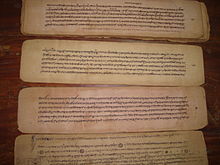
The oldest evidence of writing in Bangladesh is the Mahasthan Brahmi Inscription, which dates back to the 3rd century BCE.[266] In the Gupta Empire, Sanskrit literature thrived in the region. Bengali developed from Sanskrit and Magadhi Prakrit in the 11th century. Bengali literature is a millennium-old tradition; the Charyapada are the earliest examples of Bengali poetry. Sufi spiritualism inspired many Bengali Muslim writers. During the Bengal Sultanate, medieval Bengali writers were influenced by Arabic and Persian worksSyed Alaol was a noted secular poet and translator. The Chandidas are an example of the Bangladeshi folk literature that developed during the Middle Ages. The Bengal Renaissance shaped the emergence of modern Bengali literature, including novels, short stories and science fiction. Rabindranath Tagore was the first non-European laureate of the Nobel Prize in Literature and is described as the Bengali Shakespeare.[267] Kazi Nazrul Islam was a revolutionary poet who espoused spiritual rebellion against colonialism and fascism. Begum Rokeya was a pioneer of Bengali writing in English, with her early of work of feminist science fiction. Other renaissance icons included Michael Madhusudan Dutt and Sarat Chandra Chattopadhyay.
The writer Syed Mujtaba Ali is noted for his cosmopolitan Bengali worldview.[268] Humayun Ahmed was a popular writer of modern Bangladeshi magical realism and science fiction. Jasimuddin was a renowned pastoral poet. Shamsur Rahman was the poet laureate of Bangladesh for many years. Al Mahmud is considered one of the greatest Bengali poets to have emerged in the 20th century.Farrukh AhmedSufia KamalKaiser Haq and Nirmalendu Goon are important figures of modern Bangladeshi poetry. Notable writers of Bangladeshi novels include Mir Mosharraf Hossain, Akhteruzzaman EliasSyed WaliullahShahidullah KaiserShawkat OsmanSelina HossainTaslima NasreenHaripada DattaRazia KhanAnisul HoqueBipradash BaruaTahmima AnamNeamat ImamMonica Ali, and Zia Haider Rahman. Many Bangladeshi writers, such as Muhammad Zafar IqbalK. Anis Ahmed and Farah Ghuznaviare acclaimed for their short stories.

Women in Bangladesh

Architecture

Muzharul Islam was the pioneer of Bangladeshi modern architecture. His varied works set the course of modern architectural practice in the country. Islam brought leading global architects, including Louis KahnRichard NeutraStanley TigermanPaul RudolphRobert Boughey and Konstantinos Doxiadis, to work in erstwhile East Pakistan. Louis Kahn was chosen to design the National Parliament Complex in Sher-e-Bangla Nagar. Kahn's monumental designs, combining regional red brick aesthetics, his own concrete and marble brutalism and the use of lakes to represent Bengali geography, are regarded as one of the masterpieces of the 20th century. In more recent times, award-winning architects like Rafiq Azam have set the course of contemporary architecture by adopting influences from the works of Islam and Kahn.

Performing arts

Textiles

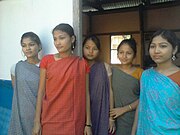
The Nakshi Kantha is a centuries-old embroidery tradition for quilts, said to be indigenous to eastern Bengal (i.e. Bangladesh). The sari is the national dress for Bangladeshi women. Mughal Dhaka was renowned for producing the finest Muslin saris, including the famed Dhakai and Jamdani, the weaving of which is listed by UNESCO as one of the masterpieces of humanity's intangible cultural heritage.[275] Bangladesh also produces the Rajshahi silk. The shalwar kameez is also widely worn by Bangladeshi women. In urban areas some women can be seen in western clothing. The kurta and sherwani are the national dress of Bangladeshi men; the lungi and dhoti are worn by them in informal settings. Aside from ethnic wear, domestically tailored suits and neckties are customarily worn by the country's men in offices, in schools and at social events.

Cuisine

White rice is the staple of Bangladeshi cuisine, along with many vegetables and lentils. Rice preparations also include Bengali biryanispulaos, and khichurisMustard sauce, gheesunflower oil and fruit chutneys are widely used in Bangladeshi cooking. Fish is the main source of protein in Bengali cuisine. The Hilsa is the national fish and immensely popular across Bangladesh. Other kinds of fish eaten include rohubutterfish, catfish, tilapia and barramundiFish eggs are a gourmet delicacy. Seafood holds an important place in Bengali cuisine, especially lobstersshrimps and dried fish. Meat consumption includes chicken, beef, muttonvenisonduck and squab. In Chittagong, Mezban feasts are a popular tradition featuring the serving of hot beef curry. In Sylhet, the shatkora lemons are used to marinate dishes. In the tribal Hill Tracts, bamboo shoot cooking is prevalent. Bangladesh has a vast spread of desserts, including distinctive sweets like RôshogollaRôshomalaiChomchomMishti Doi and KalojaamPithas are traditional boiled desserts made with rice or fruits. Halwa is served during religious festivities. Naanparathaluchi and bakarkhani are the main local breads. Black tea is offered to guests as a gesture of welcome. Kebabs are widely popular across Bangladesh, particularly seekh kebabschicken tikka and shashliks.

Festivals

Pohela Boishakh, the Bengali new year, is the major festival of Bengali culture and sees widespread festivities. Of the major holidays celebrated in Bangladesh, only Pohela Boishakh comes without any preexisting expectations (specific religious identity, culture of gift-giving, etc.). Unlike holidays like Eid al-Fitr, where dressing up in lavish clothes has become a norm, or Christmas where exchanging gifts has become an integral part of the holiday, Pohela Boishakh is really about celebrating the simpler, rural roots of the Bengal. As a result, more people can participate in the festivities together without the burden of having to reveal one's class, religion, or financial capacity. Other cultural festivals include Nabonno, and Poush Parbon both of which are Bengali harvest festivals.
Alongside are national days like the remembrance of 21 February 1952 Language Movement Day (International Mother Language Day), Independence Day and Victory Day. On Language Movement Day, people congregate at the Shaheed Minar in Dhaka to remember the national heroes of the Bengali Language Movement, and at the Jatiyo Smriti Soudho on Independence Day and Victory Day to remember the national heroes of the Bangladesh Liberation War. These occasions are observed with public ceremonies, parades, rallies by citizens, political speeches, fairs, concerts, and various other public and private events, celebrating the history and traditions of Bangladesh. TV and radio stations broadcast special programs and patriotic songs, and many schools and colleges organise fairs, festivals, and concerts that draw the participation of citizens from all levels of Bangladeshi society.[citation needed]

Sports

The team has been more successful in One Day International cricket (ODI). They reached the quarter-final of the 2015 Cricket World Cup. They also reached the semi-final of the 2017 ICC Champions Trophy. They whitewashed Pakistan in a home ODI series in 2015 followed by home ODI series wins against India and South Africa. They also won home ODI series by 4–0 in 2010 against New Zealand and whitewashed them in the home ODI series in 2013. In July 2010, they celebrated their first-ever win over England in England. In late 2012, they won a five-match home ODI series 3-2 against a full-strength West Indies National team. In 2011, Bangladesh successfully co-hosted the ICC Cricket World Cup 2011 with India and Sri Lanka. They also hosted the 2014 ICC World Twenty20 championship. Bangladesh hosted the Asia Cup on four occasions in 2000, 2012, 2014, and 2016. In 2012 Asia Cup, Bangladesh beat India and Sri Lanka but lost the final game against Pakistan. However, it was the first time Bangladesh had advanced to the final of any top-class international cricket tournament. They reached the final again at the 2016 Asia Cup. They participated at the 2010 Asian Games in Guangzhou, defeating Afghanistan to claim their Gold Medal in the first-ever cricket tournament held in the Asian Games. Bangladeshi cricketer Sakib Al Hasan is No.1 on the ICC's all-rounder rankings in all three formats of the cricket.[279]

Media and cinema

The cinema of Bangladesh dates back to 1898, when films began screening at the Crown Theatre in Dhaka. The first bioscope on the subcontinent was established in Dhaka that year. The Dhaka Nawab Family patronized the production of several silent films in the 1920s and 30s. In 1931, the East Bengal Cinematograph Society released the first full-length feature film in Bangladesh, titled the Last Kiss. The first feature film in East Pakistan, Mukh O Mukhosh, was released in 1956. During the 1960s, 25–30 films were produced annually in Dhaka. By the 2000s, Bangladesh produced 80–100 films a year. While the Bangladeshi film industry has achieved limited commercial success, the country has produced notable independent filmmakers. Zahir Raihan was a prominent documentary-maker who was assassinated in 1971. The late Tareque Masud is regarded as one of Bangladesh's outstanding directors due to his numerous productions on historical and social issues. Masud was honored by FIPRESCI at the 2002 Cannes Film Festival for his film The Clay BirdTanvir MokammelMostofa Sarwar Farooki, Humayun Ahmed, Alamgir Kabir, and Chashi Nazrul Islam are some of the prominent directors of Bangladeshi cinema.

Museums and libraries

The Northbrook Hall Public Library was established in Dhaka in 1882 in honour of Lord Northbrook, the Governor-General. Other libraries established in the British period included the Victoria Public Library, Natore (1901), the Sirajganj Public Library (1882), the Rajshahi Public Library (1884), the Comilla Birchandra Library (1885), the Shah Makhdum Institute Public Library, Rajshahi (1891), the Noakhali Town Hall Public Library (1896), the Prize Memorial Library, Sylhet (1897), the Chittagong Municipality Public Library (1904) and the Varendra Research Library (1910). The Great Bengal Library Association was formed in 1925.[285] The Central Public Library of Dhaka was established in 1959. The National Library of Bangladesh was established in 1972. The World Literature Center, founded by Ramon Magsaysay Award winner Abdullah Abu Sayeed, is noted for operating numerous mobile libraries across Bangladesh and was awarded the UNESCO Jon Amos Comenius Medal.

See also

Comments